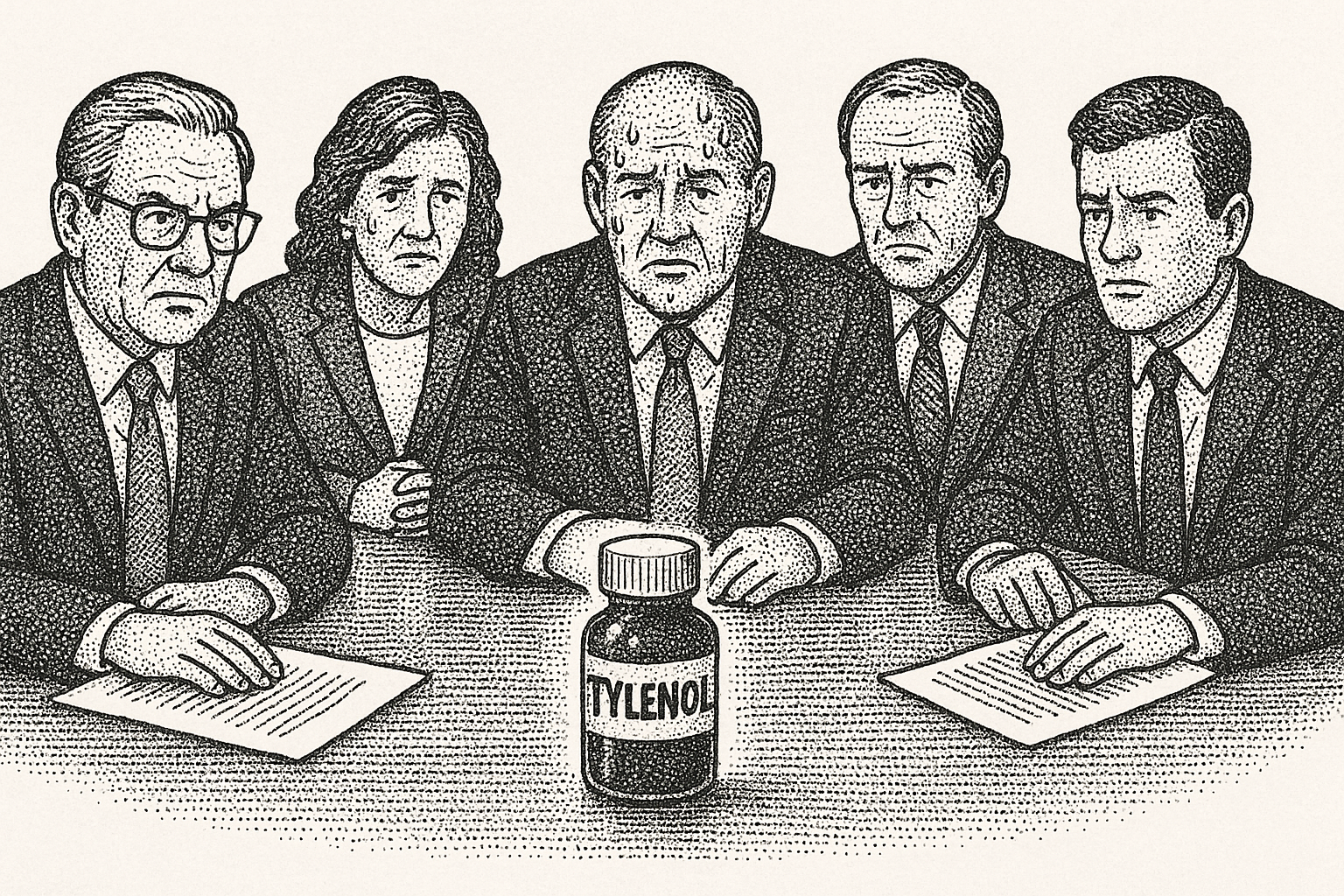
There are moments in corporate history when a board, entrusted with the stewardship of a venerable institution, appears determined to test the tensile strength of shareholder patience. Kimberly-Clark’s eagerness to align itself with Tylenol at this particular juncture qualifies as one of those moments. It is difficult to recall a recent transaction so fraught with foreseeable risk being embraced with such unguarded optimism.
For those who have not followed the matter closely, Johnson & Johnson spun off its consumer division into Kenvue last year. At the time, many observers viewed the move as an ordinary act of portfolio rationalization. Yet with the benefit of recent disclosures, including a lawsuit brought by Texas Attorney General Ken Paxton, that transaction now appears far more purposeful. The suit alleges that the risks associated with prenatal acetaminophen exposure—specifically Tylenol—were known inside Johnson & Johnson and that the spin-off was engineered, in part, to distance the parent company from what may become prodigious liabilities.
If this allegation holds, then Kimberly-Clark is not merely purchasing brands. It may be stepping into the blast radius of liabilities that Johnson & Johnson was only too eager to shed.
The investor community was right to expect that management would directly address this concern. When a Barclays analyst asked how the pending Tylenol litigation had been factored into the transaction, the moment called for clarity. Instead, Kimberly-Clark’s chief executive offered a polished but evasive assurance:
“We reviewed this transaction with incredible rigor… with the world’s foremost scientific, medical, regulatory and legal experts… and this is a generational value creation opportunity.”
It was a confident declaration, no doubt. But confidence is not indemnification. The remark conspicuously omitted the words investors most needed to hear—that Kimberly-Clark would assume no Tylenol-related liabilities, direct or indirect. In their absence, the “rigor” invoked sounded less like reassurance and more like incantation.
If the board truly secured airtight protection, one would expect management to trumpet that fact rather than rely on rhetorical ballast. Silence here is not neutral; it is meaningful.
This is no ordinary litigation environment. Acetaminophen has been thrust into the national conversation at the highest levels of government. A sitting President once suggested there was “a tremendous amount of proof or evidence” linking Tylenol to autism, and Robert F. Kennedy Jr. has spent years stoking public suspicion about the drug. One need not agree with either man to recognize the hazard: once the weight of Washington aligns against a product associated with children’s health, corporate defendants fare poorly. Few companies, however well-lawyered, prevail against the confluence of federal agencies, plaintiff attorneys, and emotionally charged public opinion.
The Texas Attorney General’s claim is particularly sobering. Citing federal health findings, Paxton asserts that prenatal acetaminophen exposure “likely causes” autism and ADHD. The suit notes that 65% of pregnant women used acetaminophen, a statistic so large as to make the potential claimant pool unprecedented. Texas alone estimates that damages could reach “tens of billions of dollars.” Extrapolated nationally, the magnitude becomes difficult to contemplate without wincing.
To overlay these prospective liabilities onto Kimberly-Clark—a company whose brand equity is inseparable from parental trust—borders on the surreal. Huggies, Pull-Ups, and Little Swimmers occupy a sanctified corner of the consumer marketplace. The company’s reputation rests on the presumption that it protects infants, not that it courts association with neurological harm. One adverse headline could undo decades of goodwill. Brand trust, once lost in this category, does not return on schedule.
There is an unfortunate precedent here. The directors of Johns-Manville once assured shareholders that asbestos concerns were exaggerated and manageable. The subsequent deluge of litigation rendered those assurances tragically hollow. The lesson from that episode was not merely that liabilities can be underestimated, but that management overconfidence in the face of compounding legal risk is a warning sign in itself.
Kimberly-Clark’s board may believe it is seizing an opportunity. What investors must determine is whether it is instead seizing a live wire. Before this transaction proceeds any further, shareholders are entitled to unambiguous answers—not superlatives, not appeals to expert consultation, but plain commitments regarding liability insulation. Anything less invites the suspicion that such protection does not exist.
A century-old company with a reputation for prudence should not gamble its future on the hope that a legal, political, and regulatory storm somehow spares it. The board’s first responsibility is not to chase “generational opportunities,” but to avoid generational errors.
Kimberly-Clark would be well-advised to pause, reflect, and consider whether it is about to embrace a problem that a larger, more legally fortified corporation deliberately abandoned. Investors should insist on it.