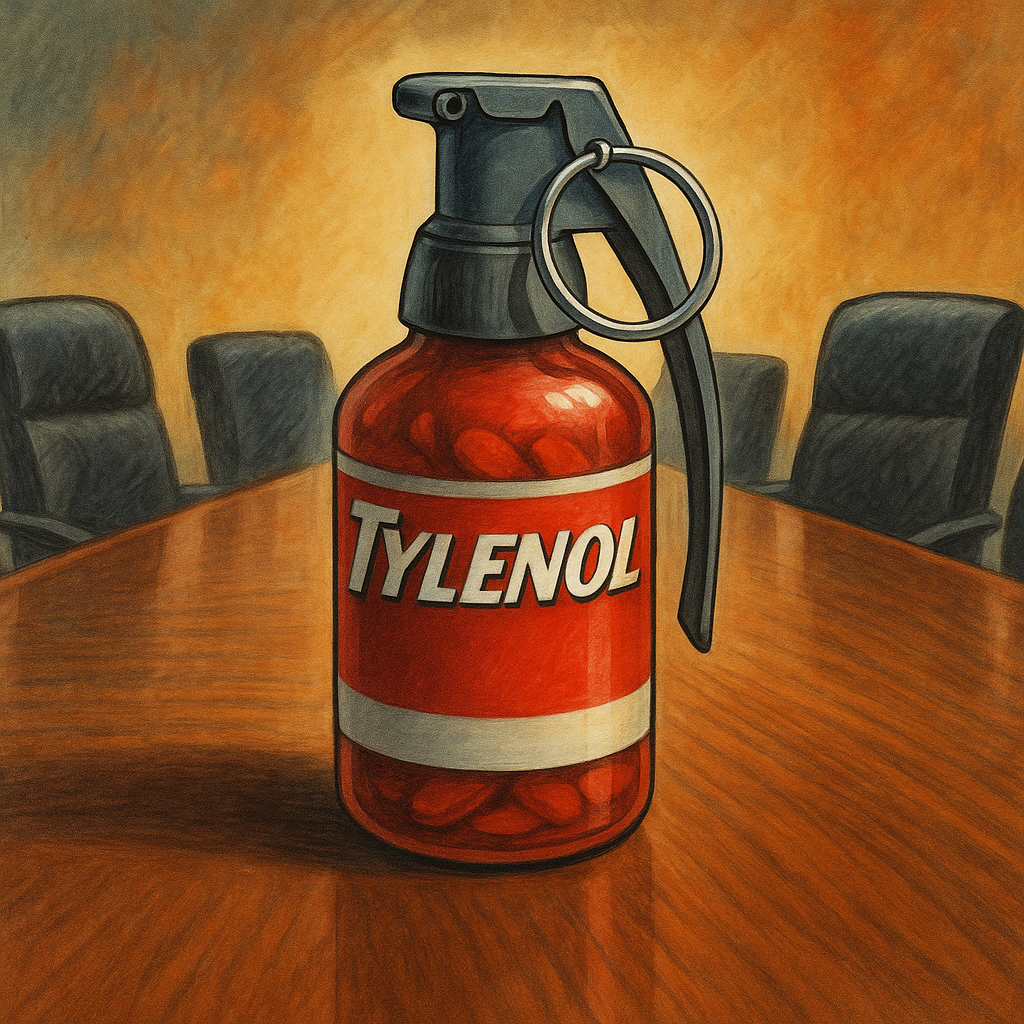
Every decade or so, a corporate board puts its hand on a hot stove, gets burned, and the rest of us get a good reminder of why oven mitts were invented. Kimberly-Clark’s sudden eagerness to shackle itself to Tylenol — at the precise moment the political, legal, and regulatory cannons are warming up — is not merely bad judgment. It is the kind of kamikaze corporate decision that makes the 1980s takeover battles look like tea parties.
Let’s not sugarcoat it: Johnson & Johnson just pulled off one of the most strategic liability escape acts in modern corporate history. They didn’t spin off Kenvue to streamline operations or “unlock value.” They spun it off so the Tylenol litigation — a tidal wave they clearly saw coming — wouldn’t take down the mothership. They ran for the exits. And here comes Kimberly-Clark, merrily strolling in as if they’ve discovered a clearance rack at Macy’s.
If this board thinks it’s walking into a brand extension, it is walking into a gunfight in a gasoline suit.
When an analyst raised the only question that mattered — how the Tylenol autism/ADHD litigation was factored into the deal — you might expect that a board courting this level of risk would have a crisp, airtight answer. Instead, what investors heard was this masterpiece of corporate self-congratulation from Kimberly-Clark’s CEO:
“We reviewed this transaction with incredible rigor… with the world’s foremost scientific, medical, regulatory and legal experts… and this is a generational value creation opportunity.”
That’s not an answer. That is the verbal equivalent of spraying cologne on a skunk and hoping nobody notices.
When a CEO leans on words like “rigor” and “foremost experts,” instead of saying, “We assume zero Tylenol-related liability, period,” it tells you everything you need to know. If protection existed, they’d flaunt it like a new yacht. The silence is the confession.
Now let’s talk about why this is not just bad — but historically foolish.
Once the federal government decides a consumer health product might be harming children, the corporate defendant rarely survives intact. And this Tylenol issue isn’t brewing quietly in scientific journals. It has already been dragged into the political hurricane.
A White House podium was used to blast acetaminophen. A sitting President went out and said there was “a tremendous amount of proof or evidence” suggesting Tylenol causes autism — and he said it as a non-doctor, which made it sound even more reckless and inflammatory. Meanwhile, RFK Jr. has been fanning these flames for years, saying he would “make the proof.”
Now, whether you like Trump or RFK Jr. is irrelevant. Whether they are right or wrong on the science is irrelevant. Investors must understand the only point that matters:
Once the White House and a Kennedy put a target on a product linked to children’s health, the FDA, DOJ, and trial bar don’t need facts — they need momentum. And momentum they have.
No corporation in history has won that fight.
Not Big Tobacco. Not Purdue Pharma. Not J&J in talc.
If J&J couldn’t stare down the federal government when the Tylenol fire started, what fantasy leads Kimberly-Clark to think it will fare better?
But the political firestorm isn’t the only death trap here — the litigation math is a guillotine on a timer.
Texas Attorney General Ken Paxton’s lawsuit lays it out in black and white: prenatal Tylenol exposure “likely causes” autism and ADHD. Sixty-five percent of pregnant women used Tylenol. Paxton says the damages alone could reach “tens of billions of dollars” — and that’s just Texas.
Now apply that across 50 states. Add the DOJ. Add the class actions. Add the inevitable copycat suits overseas. Add the fact that this plaintiff pool renews every year with every birth cohort.
This isn’t a lawsuit.
It’s a conveyor belt of liability.
And there sits Kimberly-Clark, humming and smiling like they’re acquiring scented candle brands.
The tragic comedy of all this is that Kimberly-Clark is not Exxon or Honeywell. It doesn’t sell aircraft parts or petrochemicals where lawsuits are a cost of doing business. It sells diapers. Its entire corporate identity is built on trust with parents, hospitals, and babies. If there is one brand category on Earth that cannot afford to be associated with autism litigation, it is the baby aisle.
One headline — just one — reading:
“The Huggies Company Linked to Autism Claims”
…and 150 years of brand equity goes down the drain faster than a baby wipe in a clogged nursery sink.
No amount of PR spin or “rigor” will save a diaper brand once parents believe it hurt children. That is a scarlet letter that never washes off.
Here’s the part that should make every investor’s blood boil:
J&J — the most battle-tested litigation machine in corporate America — took one look at this problem, moved Tylenol into a separate entity, and according to Texas, did so to shield itself from the explosion.
When the most lawsuit-proof company in the country flees the scene, that is not your cue to buy property there. That is your cue to leave skid marks in the parking lot.
Kimberly-Clark is not just ignoring the smoke.
It’s marching into the burning building carrying lighter fluid.
A board’s first duty is simple: Do not blow up the company.
This deal ignores that duty so completely it borders on negligence.
If Kimberly-Clark signs this agreement without iron-clad, bankruptcy-proof, successor-liability-proof insulation from every Tylenol-related claim, then investors should consider this deal a declaration of war on shareholder value.
Because no CEO speech, no “rigor,” no army of consultants, and no “foremost experts” will matter when the federal government, the plaintiffs’ bar, and public opinion decide you’re the villain in a children-harm narrative. That is a firing squad no corporation survives.
And make no mistake — Kimberly-Clark is walking onto that field voluntarily.
The last question investors should be asking is not:
“What’s the upside here?”
It’s this:
“Has the board lost its mind?”