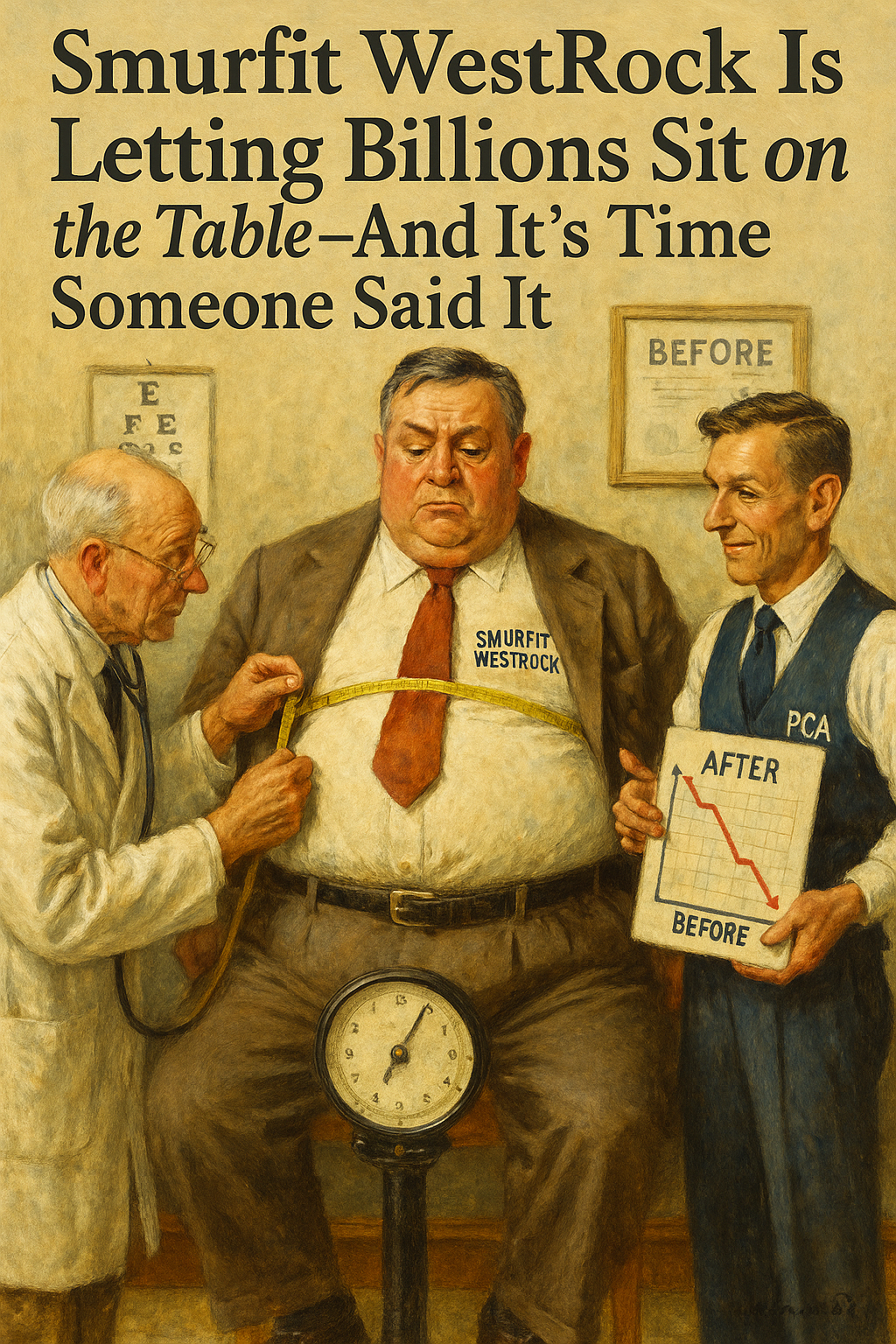
Every industry has one company that everyone whispers about but no one calls out directly. In packaging, that company is Smurfit WestRock — a bloated, sluggish, overbuilt behemoth that has been padding payrolls for years and now wants applause for “integration.”
Let’s stop pretending this story began with the merger.
WestRock was bloated before Smurfit Kappa ever entered the picture. The company carried more employees than it needed, especially in North America, and the culture tolerated it. Instead of confronting the inefficiency, management found a distraction: merge with Smurfit Kappa and hope that scale would mask the bloat.
It didn’t. It magnified it.
The merger didn’t create efficiency — it stacked one bureaucracy on top of another and put a bow on it.
And now shareholders are paying for it.
💰 The Money Being Wasted Is Not Subtle — It’s Obscene
For years, WestRock had roughly double the headcount it needed to run a North American packaging business effectively. Smurfit Kappa brought European bureaucracy to the party — committees, layers, and overhead that move at the speed of a government agency, not a business trying to earn a return.
The result?
A company with 100,000 employees doing the work that could be done by half that number — with better results.
If this company simply ran North America the way Packaging Corporation of America — the industry’s efficiency machine — runs its business, the math looks like this:
- $3–$4 billion in annual earnings unlocked
- At 6× EBITDA, that’s $18–$24 billion in value
- Equal to $25–$33 per share of upside
Which means a stock sitting in the mid-30s could be trading in the 60s or even low-70s — without selling a single mill.
And that’s before considering a higher valuation multiple that disciplined companies enjoy.
🧨 Let’s Call This What It Is
This isn’t a “transformation story.”
This is a payroll addiction.
WestRock never had the discipline to run lean — and rather than fixing itself, it merged, thinking size would save it. Instead, it built a two-headed bureaucracy, and now shareholders are the ones being asked to foot the bill while management talks about “synergies” that never show up in the numbers.
This is the corporate version of gaining weight and buying a bigger suit instead of going to the gym.
🔥 The Fix Isn’t Complicated — It’s Courageous
Here’s what Smurfit WestRock needs to do, and if management won’t do it, an activist eventually will:
- Cut the North American fat that WestRock never cut.
The problem didn’t start in Dublin — it started in Atlanta. - Stop treating payroll as a social program.
Run it like PCA: if a job doesn’t create value, it doesn’t exist. - Put results over headcount.
The company should measure success in dollars, not org charts.
Do this, and the stock becomes a winner.
Don’t do it, and someone will force it.
📍 The Bottom Line
Smurfit WestRock isn’t struggling because of markets, cycles, or inflation. Those are excuses.
The company is struggling because it refuses to confront its pre-existing bloat — the same bloat that the merger doubled down on rather than eliminated.
The tragedy is that this is a choice.
There is billions of shareholder value sitting on the table, waiting to be earned — not by innovation, not by luck, but by discipline.
The only question now is whether Smurfit WestRock wants to stay a monument to inefficiency or finally behave like a company that belongs to its shareholders rather than its payroll.
Sooner or later, someone’s going to ask the question:
If $3–$4 billion in profit is sitting there for the taking, who benefits from ignoring it?
Because it certainly isn’t the shareholders.