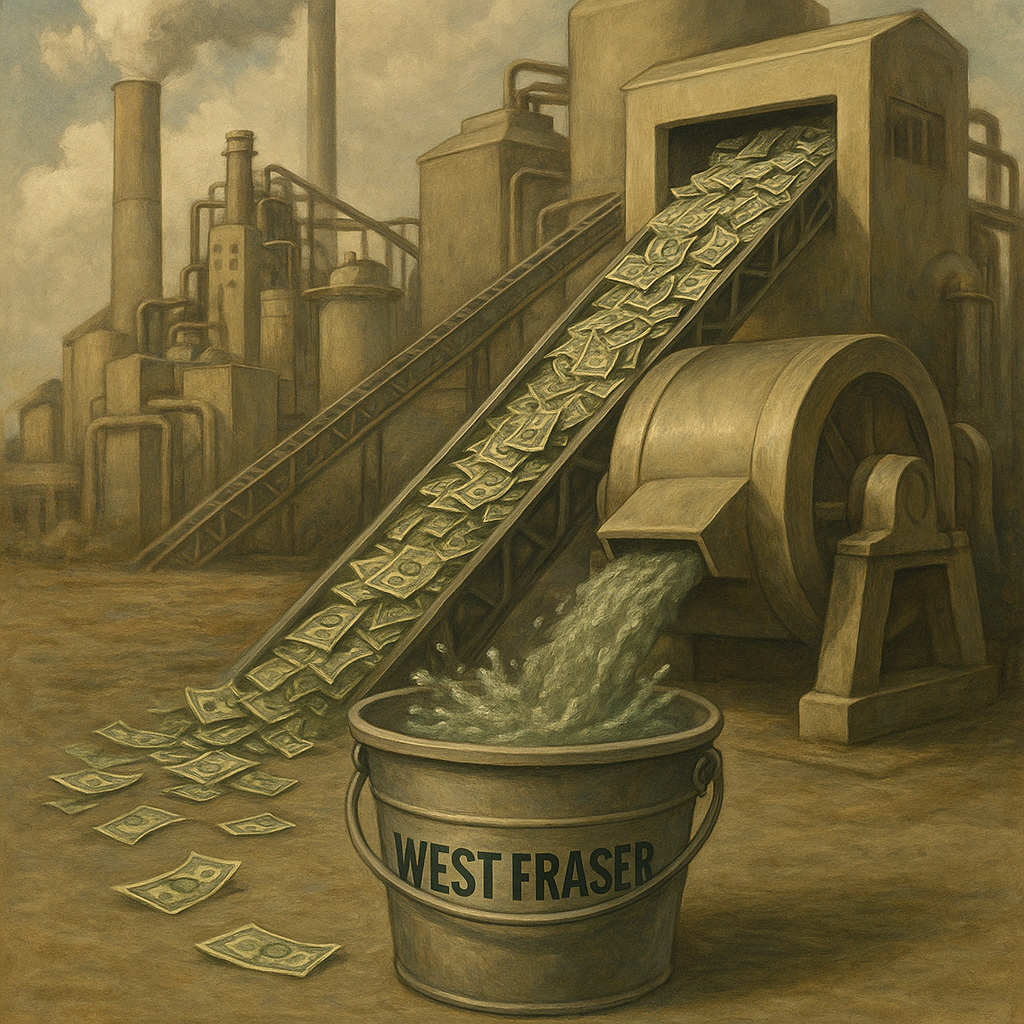
West Fraser Timber Co., the world’s largest lumber producer, has spent much of the past decade diversifying beyond sawmills, expanding into engineered wood products and pulp manufacturing while riding the volatile currents of global housing cycles. Its next move may be unusually clear: the most compelling and economically logical acquisition target in the North American forest-products space is also one of the sector’s most distressed.
Mercer International, the Vancouver-based producer of northern bleached softwood kraft pulp and mass-timber building components, is facing mounting losses brought on by weak pulp prices, a widening hardwood–softwood spread, and a cost base that places several of its mills high on the global cost curve. The combination of deep cyclical pressure and structural disadvantages has depressed Mercer’s share price and weakened the balance sheet, creating what industry analysts describe as a rare “perfect-fit” distressed acquisition candidate for West Fraser.
Several forces—economic, operational and strategic—make the logic of such a deal unusually compelling.
A Pulp Giant Struggling at the Wrong Point in the Cycle
Mercer’s third-quarter 2025 results underscored how quickly the company’s earnings power evaporates in a softwood pulp downturn. EBITDA was negative $28 million, including a $20 million non-cash inventory impairment. Segment results were equally bleak: pulp EBITDA came in at negative $13 million, while the solid-wood division, which includes lumber and cross-laminated timber (CLT), posted a $9 million operating loss.
The problem is not unique to Mercer. Global softwood pulp prices have dropped to uncomfortable levels for many producers, with China NBSK pricing near $690 per tonne and North American list prices down $120 sequentially. But Mercer’s trouble is amplified by its cost structure: high-cost fiber baskets, heavy exposure to Europe’s volatile energy markets, and mills that lack the scale economies of larger integrated groups.
“Mercer is fundamentally a swing producer,” said one industry executive. “They make money when the market is tight and pulp is above $900 in China. Below that, they struggle mightily.”
At the same time, hardwood pulp—particularly Brazilian eucalyptus—has maintained a steep price advantage of nearly $200 per tonne over softwood. That gap has driven substitution away from Mercer’s grades toward cheaper alternatives, pressuring sales realizations even as volumes remain steady.
Mercer’s cash consumption accelerated to $48 million in the quarter, up from $35 million in Q2, highlighting what analysts warn could become an untenable trajectory if markets remain weak into 2026.
For West Fraser, The Synergy Math Is Unusually Clean
If Mercer faces the wrong mix of cyclical and structural headwinds, West Fraser faces the opposite: a balance sheet capable of opportunistic expansion, and an industrial footprint that matches Mercer’s weaknesses point for point.
No company in North America controls a larger flow of sawmill residual chips—the key input for kraft pulp—than West Fraser. The company’s network of sawmills in British Columbia, Alberta, and the U.S. South produces enormous volumes of residual fiber, often well in excess of its own pulp consumption.
Mercer, by contrast, runs several mills that purchase chips at spot or contract prices that reflect the tight fiber situation in central Europe and parts of the Pacific Northwest. Analysts estimate that a West Fraser–Mercer combination could lower Mercer’s delivered fiber cost by 15% to 25%, a synergy that would drop directly to EBITDA with no corresponding increase in fixed overhead.
“West Fraser is the only player on the continent that could instantly make Mercer a lower-cost producer,” said David Larkin, an analyst at RBC Capital Markets. “It’s extremely one-to-one. They have chips. Mercer needs chips. The industrial calculus is straightforward.”
Additional integration benefits are equally material. West Fraser already operates three major pulp mills—Hinton, Quesnel River, and Cariboo (a joint venture with Mercer’s neighbor, Canfor Pulp). Folding Mercer’s Celgar and Stendal mills into the portfolio would:
- Expand West Fraser’s global pulp marketing reach
- Provide geographic diversification through Mercer’s German and Finnish operations
- Allow centralization of chemical procurement and energy contracting
- Unlock shared logistics and shipping efficiencies
Industry executives estimate the total run-rate synergy potential at $150 million to $250 million annually, a substantial number in a sector where cost curves determine survival.
A Rare Opportunity to Acquire CLT Scale, Not Just Pulp
Equally important is Mercer’s mass-timber business. The cross-laminated timber (CLT) market is growing rapidly in North America as builders, developers and government agencies seek low-carbon alternatives to steel and concrete. CLT is at the center of this push, with multistory timber buildings receiving regulatory approval across Canada and the United States.
Mercer controls about 30% of North American CLT capacity, making it one of the largest producers on the continent. The unit is currently loss-making due to weak construction demand in 2024–25, but order books have strengthened and management expects meaningful margin improvement beginning in 2026.
West Fraser is already a major player in engineered wood, with large positions in glulam, laminated veneer lumber (LVL), and oriented strand board (OSB). What it lacks is scale CLT production—a gap that Mercer fills immediately.
“Mass timber is the long game,” said a West Coast timber consultant. “Whoever controls CLT capacity controls the next twenty years of green construction. West Fraser won’t get another shot at a platform this size.”
Mercer’s CLT facilities would allow West Fraser to offer the full suite of engineered wood products, from LVL and glulam to the CLT panels needed for offices, schools, and mid-rise residential buildings. The combined group would become the most comprehensive mass-timber supplier in North America.
The Valuation Argument: Distress Creates a Window
Mercer’s depressed financial results have pushed its valuation far below replacement cost. The company trades at multiples more typical of distressed debt than of a strategic asset with 2.3 million tonnes of pulp capacity and a CLT footprint that would cost well over $1 billion to replicate.
West Fraser, meanwhile, has a rock-solid balance sheet, modest debt, and the free cash flow to fund acquisitions without threatening its credit metrics.
“West Fraser has the luxury of being patient, but opportunities like Mercer don’t come around often,” said a Toronto-based analyst. “If they want to expand internationally or bulk up their pulp segment, this is the time.”
Global Pulp Dynamics Favor Consolidation
Softwood producers have faced repeated cycles of oversupply and margin compression, particularly in Europe. Several high-cost mills are running at minimal profit or loss. Consultants argue that a rationalization of global capacity is overdue—and that strategic mergers are more likely than greenfield construction to balance the market.
A West Fraser–Mercer combination would:
- Remove duplicative overhead
- Allow optimization or repurposing of weaker assets
- Potentially prompt other consolidation among Canadian and European producers
- Improve pricing discipline in softwood pulp markets
With hardwood megaprojects coming online in Brazil and Uruguay, softwood producers must find scale efficiencies to remain competitive. Industry observers say a collapse in pricing below today’s levels would likely force more closures or mergers, with Mercer among the most exposed.
“Softwood pulp needs consolidation to survive the cost curve pressure from Latin America,” said an executive with a Scandinavian producer. “West Fraser is one of the few who can pull it off.”
Risks and Regulatory Considerations
Any deal would face scrutiny in Canada and Europe. West Fraser’s already substantial footprint in British Columbia might prompt competition concerns if regulators believe that consolidation reduces residual fiber-buying competition. European approvals may also require commitments to maintain employment levels at Mercer’s mills.
But analysts argue that the global nature of pulp markets and the presence of several large competitors—including Suzano, Arauco, UPM, and Stora Enso—reduces antitrust risk. West Fraser’s existing pulp footprint is modest relative to its lumber operations, and a merger with Mercer would not create a dominant global market share.
A Strategic Fit Rarely This Neat
In cyclical materials industries, transformative deals often arise at the bottom of the cycle, when distressed assets can be acquired at rational prices and integrated into larger, more efficient platforms. Mercer is precisely such an asset: structurally challenged but industrially complementary, operationally salvageable but financially weakened.
For West Fraser, the logic is almost unusually linear. The company gains:
- Cheaper fiber for Mercer’s pulp mills
- A large-scale CLT business
- International diversification
- Stronger pulp marketing leverage
- Meaningful cost synergies
Mercer, in turn, gains:
- A stable low-cost fiber supply
- A stronger balance sheet
- Operational expertise in pulp and wood products
- Relief from the volatility that has eroded its equity value
If West Fraser’s leadership has been looking for a long-term strategic move that aligns with its core competencies in fiber, engineered wood, and cyclical asset management, Mercer International may be the most obvious opportunity on the table.
As one industry veteran put it: “If West Fraser doesn’t buy them, someone else eventually will. Assets like these don’t stay distressed forever.”